Certificate of Analysis
Independent laboratory testing confirms purity and composition of this research compound.
ENDO PASSED
Compound Specifications
| Form | Lyophilized powder |
| Vial size | 5 mg |
| Kit size | 10 vials per kit |
| Purity | ≥99% (HPLC verified) |
| Mass confirmation | ESI-MS confirmed |
| Heavy metals | <10 ppm (ICP-MS) |
| Endotoxin | <1.0 EU/mg (LAL) |
| Residual moisture | <5.0% (Karl Fischer) |
| Storage — lyophilized | −20°C, protected from light |
| Lyophilized stability | 24 months from manufacture |
| Reconstitution | Bacteriostatic water for injection |
| Storage — reconstituted | 4°C, use within 28 days |
| Packaging | Sterile glass vial · rubber stopper · aluminium crimp cap |
What Is Sermorelin?
Sermorelin (GHRH 1-29 NH₂) is a synthetic 29-amino-acid analogue corresponding to the N-terminal fragment of endogenous growth hormone-releasing hormone (GHRH 1-44). It is the minimal active fragment required for full GH secretagogue activity at the GHRH receptor (GHRHR) on anterior pituitary somatotrophs. Sermorelin was the first synthetic GHRH analogue approved by the FDA (1997, paediatric GHD diagnosis; withdrawn 2008 due to commercial discontinuation, not safety).
Research with sermorelin focuses on pituitary axis biology, somatotroph function, GH pulsatility modelling, and the physiology of age-related somatotropic decline (somatopause). As a direct GHRHR agonist that preserves physiological feedback loops (unlike exogenous GH administration), it is a valuable tool compound for studying the hypothalamic-pituitary-somatotropic axis in intact experimental systems.
Research Overview
| Molecular formula | C₁₄₉H₂₄₆N₄₄O₄₂S |
| Molecular weight | 3,357.9 g/mol |
| Sequence length | 29 amino acids (GHRH 1–29 amide) |
| Receptor target | GHRH receptor (GHRHR) — pituitary somatotrophs |
| Primary research focus | GH pulsatility, somatotroph biology, HPA/HPG-axis interaction |
| Secondary research focus | Somatopause models, IGF-1 axis, body composition research |
| Half-life (estimated) | ~10–20 minutes in plasma |
| Prior FDA status | Approved 1997 (paediatric GHD diagnosis); discontinued 2008 |
Research Notes
Sermorelin triggers endogenous GH secretion in a pulsatile manner that mirrors physiological release, in contrast to exogenous recombinant GH which produces supraphysiological sustained elevation. In somatopause models (aged rodents, primates), sermorelin administration restores GH pulse amplitude toward younger profiles, making it useful for studying somatotropic axis decline. IGF-1 upregulation follows GH release after sermorelin administration with expected lag kinetics — typically 6–12 hours in rodent models. Its short plasma half-life means that pulsatile administration protocols (mimicking endogenous GHRH rhythm) are important for maintaining receptor sensitivity and avoiding downregulation in chronic study designs.
Frequently Asked Questions
- How does sermorelin compare to CJC-1295 in research use?
- Sermorelin (GHRH 1-29) has a ~10–20 minute half-life. CJC-1295 incorporates a Drug Affinity Complex (DAC) or maleimide modification that extends half-life to days. Sermorelin is preferred when studying acute, pulsatile GH release dynamics; CJC-1295 is preferred when studying sustained somatotropic stimulation or GH output integrated over longer periods.
- What is the significance of the C-terminal amidation?
- The –NH₂ amide at the C-terminus of sermorelin is required for GHRHR binding affinity and biological activity. It protects against carboxypeptidase degradation and contributes to receptor docking geometry. Research-grade sermorelin must be verified for correct amidation via mass spectrometry before use.
- What are typical research reconstitution protocols?
- Standard protocols dissolve 5 mg in 1–2 mL bacteriostatic water to yield a 2.5–5 mg/mL stock. Sermorelin is stable at 4°C for 28 days post-reconstitution. For acute pulsatile studies, aliquots of the stock solution are prepared fresh to minimise degradation between administrations.
What is Sermorelin used for in research?
Sermorelin is studied as the minimal active fragment of endogenous GHRH required for full somatotroph stimulation, making it a research tool for examining GH pulsatility, IGF-1 axis dynamics, and somatopause biology. Phase I/II studies established its GH secretagogue profile, and it has been FDA-approved as Geref® for GH deficiency diagnosis, providing a validated pharmacological baseline for research. It is used in studies of HPA/HPG-axis interactions and body composition.
Is Sermorelin available as lyophilized vials?
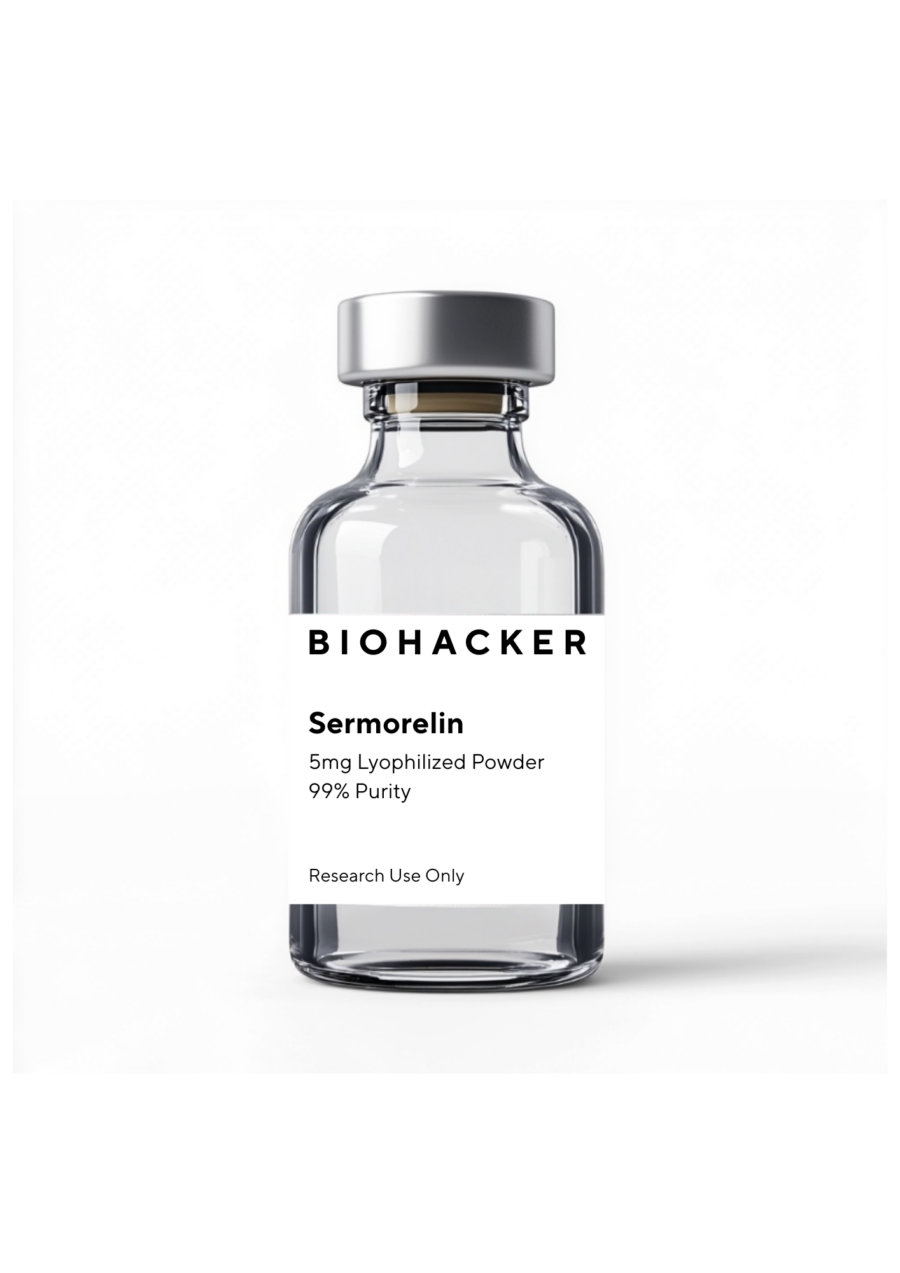
Yes. BIOHACKER’s Sermorelin is supplied as lyophilized powder in individual vials. Each vial contains 5 mg of research-grade Sermorelin at ≥99% HPLC purity. Reconstitute with bacteriostatic water before use. For research purposes only.
What purity is BIOHACKER’s Sermorelin?
≥99% by HPLC, with ESI-MS mass confirmation and endotoxin testing to USP <85> standards. Full Certificate of Analysis is available on the COA page and traceable by batch number.
Is this for human consumption?
No. Sermorelin from BIOHACKER is sold strictly for in vitro research and laboratory use. It is not intended for human or veterinary use and is not a dietary supplement or pharmaceutical product.
Ready to order? Add to Cart — $45
Research Use Only. This product is intended for in-vitro laboratory research purposes only. Not for human consumption, clinical use, veterinary use, or food/drug manufacturing. Not evaluated or approved by the FDA or any regulatory authority. Handle with appropriate laboratory precautions. Keep out of reach of children.
Reviews
There are no reviews yet.