Certificate of Analysis
Independent laboratory testing confirms purity and composition of this research compound.
ENDO PASSED
Stack Rationale
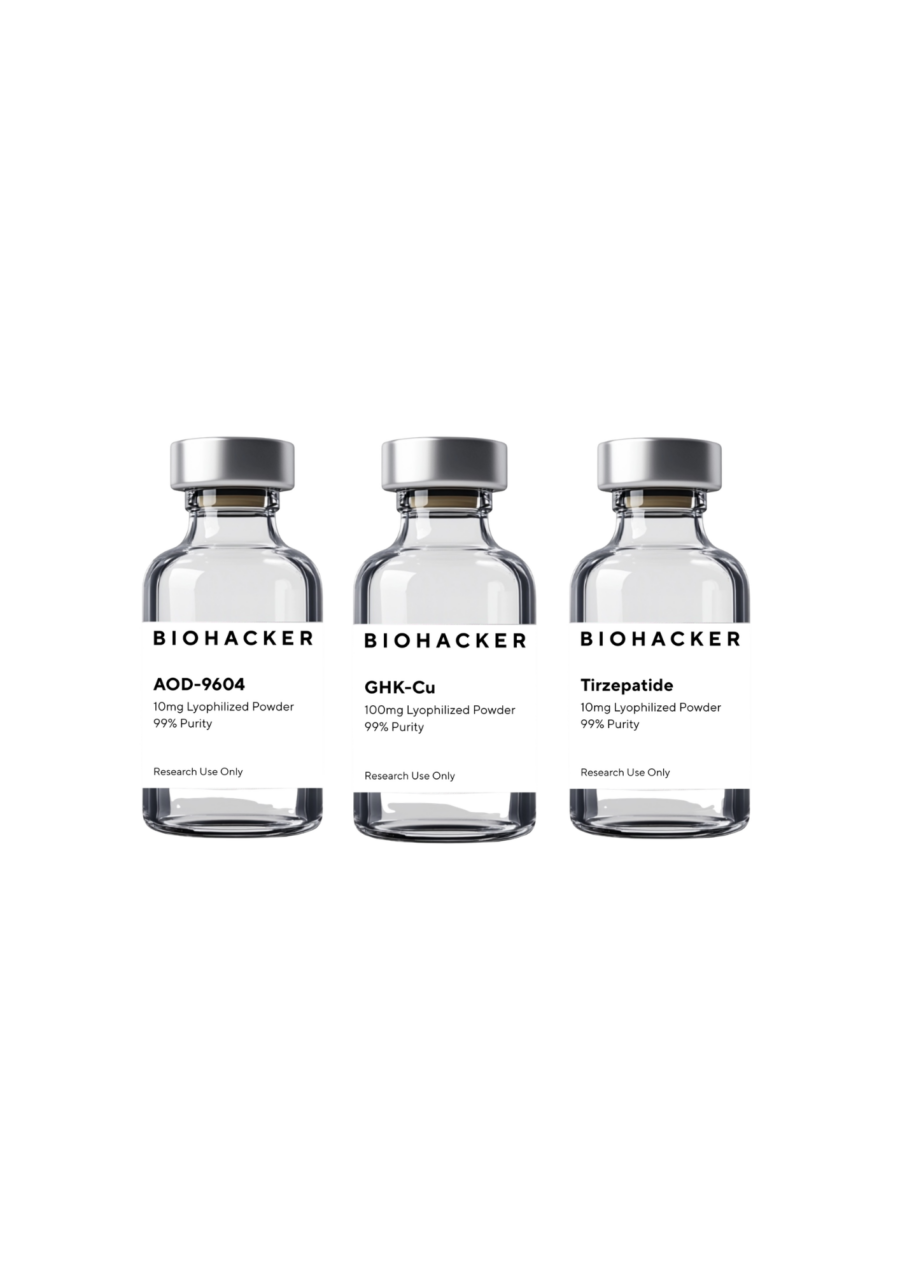
The Tirzepatide Protocol combines the dual incretin receptor agonist tirzepatide (GIP/GLP-1R) with AOD-9604 for selective adipocyte lipolysis and GHK-Cu for ECM and antioxidant support. This combination is designed for researchers studying the metabolic and tissue-level consequences of sustained dual incretin receptor activation — particularly the adipose and connective tissue biology that accompanies significant body composition change in animal models. The stack is positioned at the intersection of incretin pharmacology, adipocyte biology, and ECM remodelling research.
What’s Included
| Compound | Vial dose | Qty | Mechanism |
| Tirzepatide | 5 mg | 1 vial | GIP/GLP-1R dual agonist — insulin secretion, appetite, adipocyte metabolism |
| AOD-9604 | 10 mg | 1 vial | hGH(176-191) fragment — adipocyte beta-3 AR lipolysis, no IGF-1 effect |
| GHK-Cu (Copper Tripeptide) | 100 mg | 1 vial | ECM remodelling, collagen synthesis, antioxidant defence |
| Form | Lyophilized powder (all vials) |
| Purity | ≥99% (HPLC verified, per vial) |
| Mass confirmation | ESI-MS confirmed (per vial) |
| Heavy metals | <10 ppm (ICP-MS) |
| Endotoxin | <1.0 EU/mg (LAL) |
| Residual moisture | <5.0% (Karl Fischer) |
| Storage — lyophilized | −20°C, protected from light |
| Lyophilized stability | 24 months from manufacture |
| Reconstitution | Bacteriostatic water for injection (per compound) |
| Storage — reconstituted | 4°C, use within 28 days |
| Packaging | Sterile glass vials · rubber stoppers · aluminium crimp caps |
Research Framework
| Compound | Adipose-related mechanism | Supporting mechanism |
| Tirzepatide | GIPR on adipocytes → enhanced lipolysis + insulin-independent lipid oxidation; GLP-1R → reduced lipogenesis via appetite/energy balance | Beta-cell preservation, hepatic lipid reduction via GIPR |
| AOD-9604 | Beta-3 adrenergic receptor activation in adipocytes → direct lipolysis independent of incretin pathways | No IGF-1 axis perturbation — useful for isolating GH fragment effects from upstream axis |
| GHK-Cu | Regulates adipose ECM — important in adipose tissue remodelling during fat loss (loose collagen fibres, adipocyte depopulation) | Systemic antioxidant support (SOD/catalase), anti-inflammatory signalling |
Research Notes
The tissue-level consequences of rapid adipose reduction in animal models include ECM restructuring — the fibrous matrix surrounding adipocytes must be remodelled as fat cells shrink and the tissue reorganises. GHK-Cu’s dual role in stimulating collagen synthesis AND activating MMP-mediated ECM breakdown positions it as a relevant tool compound for studying adipose tissue architecture changes that accompany body composition interventions. AOD-9604 provides a lipolytic stimulus that is mechanistically independent of both the tirzepatide pathways, allowing researchers to study additive vs. synergistic lipolysis via separate receptor systems. Tirzepatide’s GIPR-mediated direct adipocyte effects (demonstrated in adipocyte culture by Samms et al., Cell Metabolism 2020) are complemented by AOD-9604’s beta-3 AR activation at the adipocyte level — two distinct receptors, same target cell.
Frequently Asked Questions
- What makes tirzepatide different from semaglutide for adipose biology research?
- Tirzepatide’s GIPR agonism directly targets adipocytes — GIP receptors are expressed on adipocytes and promote lipid oxidation and lipolysis via PKA/cAMP signalling. This is a direct adipocyte effect not shared by GLP-1R agonism (GLP-1R expression on adipocytes is low or absent in most species). Tirzepatide therefore has a more direct adipocyte mechanism, while semaglutide’s fat loss is primarily mediated indirectly via reduced caloric intake and systemic energy balance.
- Why is GHK-Cu included at 100 mg?
- GHK-Cu is a small tripeptide (MW ~340 Da) used at higher concentrations in tissue culture models. The 100 mg vial supports multiple experiments across a range of concentrations (1 µM to 1 mM) for cell-type titration, dose-response, and mechanism experiments. Adipose stromal cell (ASC) and pre-adipocyte models studying GHK-Cu’s ECM effects typically use 10–100 µM concentrations, consuming relatively more material per experiment than higher-MW peptides.
- Is there a logical sequencing to using these three compounds in animal model studies?
- Yes. In chronic body composition studies, tirzepatide would typically be the primary intervention (aligned with its clinical once-weekly administration design). AOD-9604 can be co-administered to study additive direct lipolytic effects. GHK-Cu administration is most informative during the adipose remodelling phase (weeks 4–12 in rodent studies), when matrix reorganisation is actively occurring following fat mass reduction. This sequencing approach is common in multi-compound mechanistic studies.
What compounds are in the The Tirzepatide Protocol?
The The Tirzepatide Protocol includes: Tirzepatide (5 mg), AOD-9604 (10 mg), and GHK-Cu (100 mg). This stack combines a dual incretin receptor agonist (Tirzepatide) with a selective adipocyte lipolytic agent (AOD-9604) and an ECM remodelling peptide (GHK-Cu). It is designed for researchers studying the metabolic and connective tissue biology accompanying sustained dual incretin receptor activation.
Are the The Tirzepatide Protocol vials pre-mixed or individual?
Yes — each compound ships as a separate, individually labelled lyophilized vial. They are not pre-mixed. Each vial is labelled with compound name, dose, batch number, and storage instructions to ensure clear identification throughout the research workflow.
What purity are the compounds in the The Tirzepatide Protocol?
All compounds are ≥99% by HPLC, with ESI-MS mass confirmation and endotoxin testing to USP <85> standards. Full Certificate of Analysis documentation is available on the COA page and traceable by batch number for each compound.
Is this for human consumption?
No. The The Tirzepatide Protocol from BIOHACKER is sold strictly for in vitro research and laboratory use. It is not intended for human or veterinary use and is not a dietary supplement or pharmaceutical product.
Ready to order? Add to Cart — $708
Research Use Only. This product is intended for in-vitro laboratory research purposes only. Not for human consumption, clinical use, veterinary use, or food/drug manufacturing. Not evaluated or approved by the FDA or any regulatory authority. Handle with appropriate laboratory precautions. Keep out of reach of children.
Reviews
There are no reviews yet.