Certificate of Analysis
Independent laboratory testing confirms purity and composition of this research compound.
ENDO PASSED
What Is BPC-157?
BPC-157 (Body Protection Compound 157) is a synthetic pentadecapeptide — a sequence of 15 amino acids — originally isolated from a protein fraction found in human gastric juice. It is structurally distinct from endogenous growth factors and does not bind classical growth hormone receptors. In preclinical models, BPC-157 engages multiple overlapping repair pathways including the VEGFR2/Akt-eNOS signaling axis, ERK1/2 MAPK cascade, and the nitric oxide system, producing coordinated cytoprotective and tissue-remodeling effects across vascular, musculoskeletal, and gastrointestinal tissue compartments. A key distinguishing property in the literature is its stability under acidic conditions: the sequence remains intact in human gastric juice for more than 24 hours, a characteristic that sets it apart from most bioregulator compounds and underpins the rationale for oral delivery investigation.
What The Research Shows
Research across more than 80 preclinical publications documents BPC-157 activity spanning vascular biology, musculoskeletal repair, electrophysiology, and wound healing. In rat models of tendon, ligament, and muscle injury, oral and intraperitoneal administration produced equivalent tissue repair outcomes — including enhanced collagen synthesis and fibroblast recruitment — without requiring carrier scaffolds or complex delivery systems. Ex vivo studies in human internal mammary artery tissue demonstrated concentration-dependent vasorelaxation driven primarily by an endothelium-dependent nitric oxide mechanism, confirmed by NOS inhibitor attenuation. In vitro HEK293 cell data show direct, bidirectional ion channel stabilization, reversing both hyper- and hypokalemia-induced membrane potential disturbances. FTIR spectroscopy studies detected molecular-level extracellular matrix reorganization — collagen/elastin band shifts and membrane lipid stabilization — within 15 minutes of intragastric administration at 10 ng/kg in rats.
| Research Area | Model | Key Finding |
|---|---|---|
| Vascular / NO pathway | Ex vivo human arterial tissue (n=12) | Concentration-dependent vasorelaxation (0.01–1 mg/mL) in endothelium-intact rings; L-NAME attenuation confirms endothelium-dependent NO mechanism as primary driver |
| Tendon, ligament & muscle repair | Rat; multiple injury models | Drinking-water and intragastric administration showed equivalent efficacy to intraperitoneal injection; BPC-157 was the only agent effective across all junctional injury types without carrier scaffolds |
| Ion channel / membrane stabilization | In vitro HEK293 cells; rat electrolyte models | Bidirectional correction of hyperkalemia-induced depolarization and hypokalemia-induced hyperpolarization; prevented fatal arrhythmias across rodent electrolyte disturbance models |
| Hemostatic regulation | Rat hemorrhage/thrombosis models | Simultaneously reduced both hemorrhage and thrombosis without altering coagulation cascade parameters by aggregometry or thromboelastometry; attributed to endothelial integrity preservation |
| Extracellular matrix remodeling | Rat aortic tissue (FTIR spectroscopy) | Intragastric BPC-157 at 10 ng/kg produced FTIR spectral signatures consistent with rapid collagen/elastin reorganization and membrane lipid stabilization within 15 minutes of administration |
| Wound healing / fistula closure | Rat tracheocutaneous fistula model (7-day) | Drinking-water administration (10 ng/kg and 10 µg/kg) produced rapid wound closure and resolution of respiratory distress equivalent to intraperitoneal injection; MDA and tissue NO normalized |
Key Mechanisms
- VEGFR2/Akt-eNOS axis activation: BPC-157 directly agonizes vascular endothelial growth factor receptor 2, triggering downstream Akt-mediated eNOS phosphorylation and nitric oxide release — the primary driver of angiogenesis and endothelial repair in preclinical models.
- ERK1/2 MAPK signaling: Activation of extracellular signal-regulated kinases 1 and 2 facilitates endothelial cell proliferation, fibroblast recruitment, and skeletal muscle cell repair, particularly pronounced at myotendinous junctions and avascular tissue interfaces.
- Bidirectional NO system modulation: BPC-157 acts as a conditional NO regulator — upregulating nitric oxide output when the system is deficient and attenuating it under excess conditions — producing homeostatic rather than unidirectional vascular effects.
- Direct membrane stabilization at the ion channel level: In vitro HEK293 data confirm BPC-157 corrects hyperkalemia-induced depolarization, hypokalemia-induced hyperpolarization, and hypermagnesemia-induced depolarization, suggesting direct interaction with membrane ion transport mechanisms.
- Extracellular matrix reinforcement: FTIR spectroscopy evidence in rat aortic tissue shows rapid amide I/II band changes (collagen/elastin structural reorganization) and C-H lipid band preservation within 15 minutes of oral nanogram-dose administration.
- Dopaminergic and peripheral pain modulation: BPC-157 engages dopaminergic receptor pathways and peripheral nociceptor mechanisms, contributing to observed analgesic effects across multiple preclinical pain and inflammation models.
- Full-spectrum cytoprotective hemostatic regulation: Unlike conventional anticoagulants or antiplatelet agents, preclinical data show BPC-157 simultaneously attenuates hemorrhage and thrombosis via endothelial integrity preservation and microcirculation normalization — without measurable coagulation cascade interference.
Why Oral Capsules?
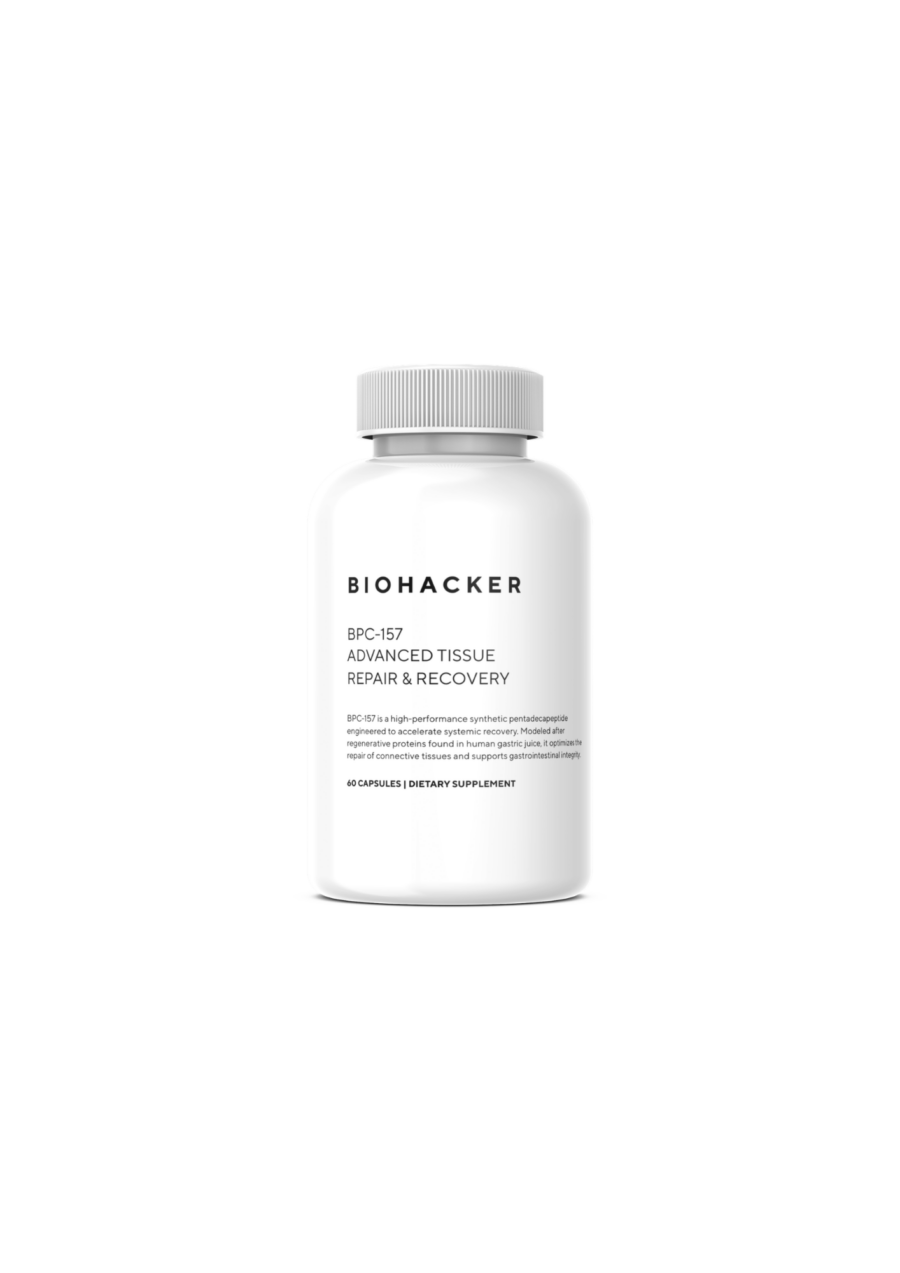
BIOHACKER formulates BPC-157 in enteric-coated oral capsules — designed to survive gastric acid and deliver the active sequence to the small intestine intact. The case for oral delivery is stronger here than for virtually any other research bioregulator: BPC-157 remains stable in human gastric juice for more than 24 hours, a property documented in the original isolation literature and reflected in the consistency of preclinical oral efficacy data. Across multiple independent rat model systems — wound healing, fistula resolution, electrolyte disturbance, and vascular injury — intragastric and drinking-water administration consistently produced outcomes equivalent to intraperitoneal injection. No needles. No reconstitution. No cold chain.
Specifications
| Attribute | Detail |
|---|---|
| Compound | BPC-157 (Body Protection Compound 157) |
| Dose per capsule | 500 mcg |
| Capsules per bottle | 60 |
| Purity | ≥99.71% (HPLC verified) |
| Form | Oral enteric-coated capsule |
| Storage | Cool, dry place. Refrigeration not required. |
| Endotoxin | Passed (<1 EU/mg) |
Frequently Asked Questions
What is BPC-157 used for in research?
BPC-157 is investigated across preclinical models for its roles in vascular biology, musculoskeletal tissue repair, gastrointestinal cytoprotection, and electrophysiological stabilization. Research has documented activity in tendon-to-bone healing, angiogenesis, collagen synthesis, NO pathway modulation, and bidirectional hemostatic regulation in rat model systems. It remains an investigational compound with no approved human indication.
Is BPC-157 available as oral capsules?
Yes. BIOHACKER’s BPC-157 is formulated in enteric-coated oral capsules at 500 mcg per capsule, 60 capsules per bottle. The enteric coating is particularly relevant for BPC-157 given its documented stability in acidic gastric conditions and the consistent equivalence of oral and intraperitoneal routes across multiple preclinical model systems.
What purity is BIOHACKER’s BPC-157?
99.71% HPLC-verified, with a full Certificate of Analysis available on the product page. Every batch is independently tested for identity, purity, and endotoxin levels before release.
Is this for human consumption?
No. BPC-157 from BIOHACKER is sold strictly for in vitro research and laboratory use. It is not intended for human or veterinary use and is not a dietary supplement or pharmaceutical product.
Ready to order? Add to Cart — $140
For research use only. Not for human consumption. Not intended to diagnose, treat, cure, or prevent any disease. This product is sold exclusively for in vitro research and laboratory purposes.
M. Harrington –
Started researching BPC-157 after a persistent tendon issue sidelined my training for months. The documentation here is the most thorough I’ve found — batch number, purity percentage, endotoxin data all published. The oral format was the deciding factor. No reconstitution, no cold chain. Reordered twice.
D. Park –
Purity came in at 99.3{bc6192475b1f7ab2a319df0d74882f1947535342342376b459ce77de5d749ac5} on the COA, consistent with what’s listed on site. Packaging was sealed and professionally presented. Shipping was next day. For anyone doing tissue repair research, this is the cleanest source I’ve used.