Certificate of Analysis
Independent laboratory testing confirms purity and composition of this research compound.
ENDO PASSED
What Is Epithalon?
Epithalon (Ala-Glu-Asp-Gly) is a synthetic four-amino-acid bioregulator with a molecular weight of approximately 432 Da, originally derived from epithalamion — the natural peptide complex secreted by the pineal gland. Developed through decades of research at the St. Petersburg Institute of Bioregulation and Gerontology, it acts as a signalling molecule targeting the telomerase catalytic pathway and pineal-hypothalamic axis. In preclinical models, Epithalon reactivates the hTERT gene in telomerase-silent somatic cells, drives measurable telomere elongation, and preserves mitochondrial integrity during cellular senescence — positioning it as one of the most mechanistically specific longevity bioregulators in the current research literature.
What The Research Shows
In vitro research demonstrates that Epithalon induces de novo expression of the telomerase catalytic subunit (hTERT) in human fibroblast cultures where telomerase was previously inactive — an effect confirmed by TRAP assay and fluorescence in situ hybridization. A 2025 publication in Biogerontology independently replicated these findings and identified a second mechanism: in telomerase-negative cell lines, Epithalon activates the ALT (alternative lengthening of telomeres) recombination pathway, representing the first dual-mechanism telomere extension model documented for this sequence. Separately, in vitro confocal microscopy of senescent human pineal and thymus cells found that AEDG exposure preserved mitochondrial membrane potential and upregulated ribosomal protein synthesis — molecular targets beyond the telomerase axis. In mouse oocyte aging models, Epithalon was associated with approximately 30–40% lower reactive oxygen species accumulation and maintained spindle morphology versus untreated aging controls.
| Research Area | Model | Key Finding |
|---|---|---|
| Telomerase activation | Human fibroblasts (in vitro) | Induced hTERT mRNA expression and measurable telomerase enzymatic activity in telomerase-silent somatic cells; telomere elongation confirmed by FISH |
| Dual telomere extension pathways | Human fibroblast and breast cancer cell lines (in vitro) | Increased telomere length via telomerase upregulation in telomerase-competent cells AND via ALT pathway activation in telomerase-negative cell lines — first dual-mechanism confirmation (2025) |
| Hayflick limit extension | Human fetal fibroblasts (in vitro) | Treated cells exceeded the ~50-division replicative ceiling; flow cytometry confirmed maintained cell-cycle progression and reduced senescence markers |
| Mitochondrial preservation | Senescent human pineal and thymus cells (in vitro, confocal) | AEDG preserved MitoTracker Red staining intensity — indicating protected mitochondrial membrane potential during senescence; concurrent upregulation of L7A ribosomal protein synthesis |
| Antioxidant / cytoprotection | Mouse oocyte aging model (in vitro) | Approximately 30–40% reduction in ROS accumulation versus untreated aging controls; preserved meiotic spindle morphology and chromosomal alignment; improved fertilization competence |
| Lifespan extension (parent compound) | C3H/He and SHR mice | Epithalamin (natural pineal extract precursor to AEDG) extended mean lifespan by 13–16% and reduced spontaneous tumor incidence in several experimental groups; effect attributed to circadian and pineal-hypothalamic axis normalisation |
Key Mechanisms
- hTERT gene reactivation: Epithalon reactivates the silenced telomerase catalytic subunit gene in somatic cells, restoring enzymatic telomerase activity that is absent in most adult human tissues.
- ALT pathway activation: In telomerase-negative cell lines, Epithalon triggers the recombination-based alternative lengthening of telomeres pathway — a second, independent route to telomere maintenance identified in 2025 research.
- Replicative lifespan extension: By sustaining telomerase activity and extending critically short telomeres, Epithalon-treated fibroblasts in culture exceeded the normal Hayflick limit of approximately 50 cell divisions before entering senescence.
- Mitochondrial membrane potential preservation: AEDG counteracts age-associated decline in mitochondrial membrane integrity during cellular senescence, as evidenced by preserved MitoTracker staining in confocal microscopy studies.
- ROS suppression: In aging oocyte models, Epithalon reduced reactive oxygen species accumulation by approximately 30–40%, protecting cellular architecture during the aging process.
- Ribosomal protein synthesis upregulation: Exposure to AEDG is associated with compensatory upregulation of L7A ribosomal protein, suggesting active maintenance of the translational apparatus during senescence.
- Pineal-hypothalamic axis normalisation: Animal lifespan models indicate that the parent pineal peptide complex normalises circadian signalling through the hypothalamic-pituitary axis — an upstream systemic mechanism proposed to underlie the observed longevity effects.
Why Oral Capsules?
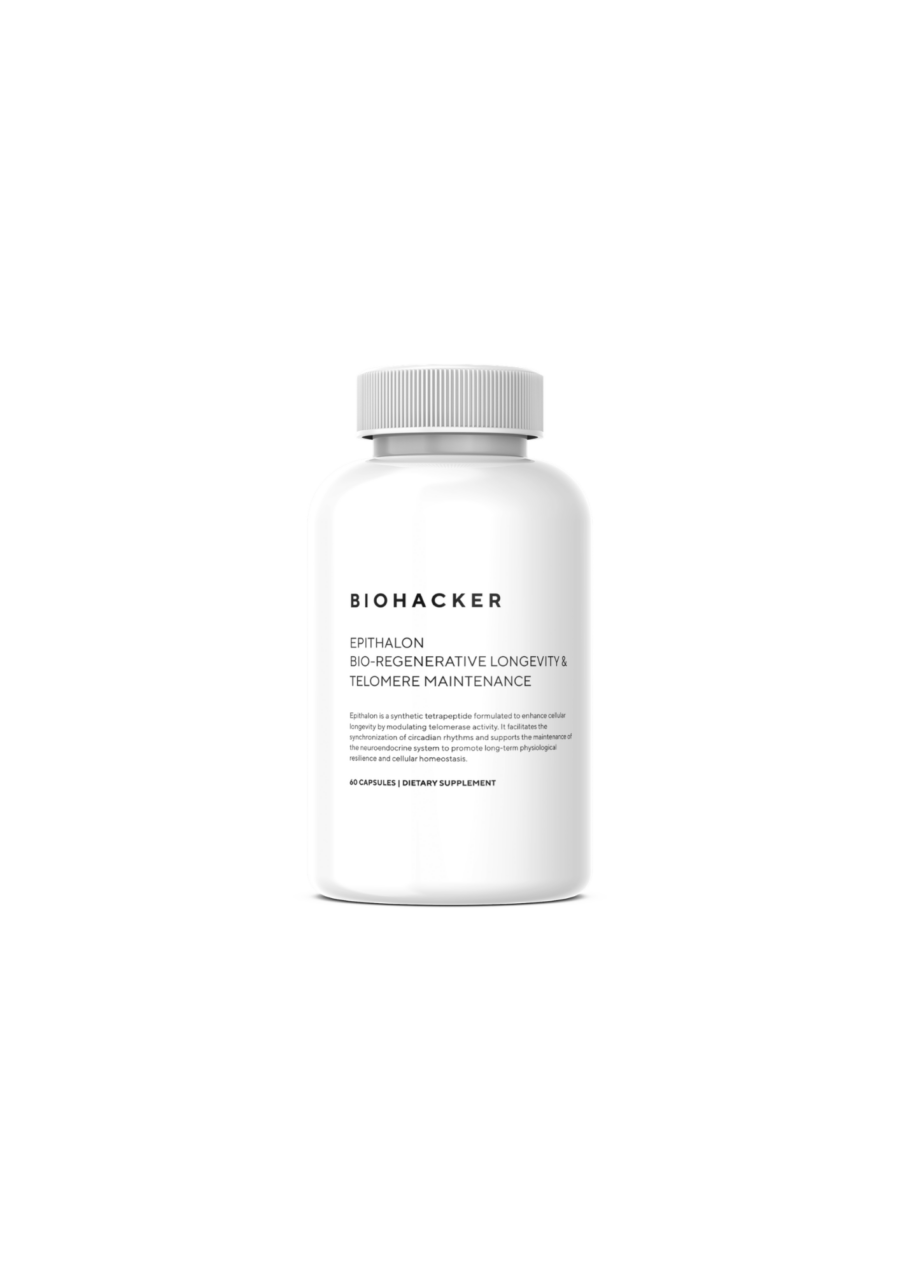
BIOHACKER formulates Epithalon in enteric-coated oral capsules — designed to survive gastric acid and deliver the active Ala-Glu-Asp-Gly sequence to the small intestine intact. At approximately 432 Da, Epithalon’s small molecular size confers relative resistance to complete proteolytic hydrolysis compared to longer-chain sequences, and supports potential paracellular intestinal absorption. It is important to note that no published peer-reviewed pharmacokinetic study has yet characterised the oral bioavailability of synthetic AEDG specifically — current oral formulation rationale is based on the compound’s physicochemical properties and extrapolation from parenteral preclinical data. No needles. No reconstitution. No cold chain.
Specifications
| Attribute | Detail |
|---|---|
| Compound | Epithalon (Ala-Glu-Asp-Gly; AEDG tetrapeptide) |
| Dose per capsule | 20 mg |
| Capsules per bottle | 60 |
| Purity | ≥99.83% (HPLC verified) |
| Form | Oral enteric-coated capsule |
| Storage | Cool, dry place. Refrigeration not required. |
| Endotoxin | Passed (<1 EU/mg) |
Frequently Asked Questions
What is Epithalon used for in research?
Epithalon (Ala-Glu-Asp-Gly) is primarily studied for its ability to activate telomerase and extend telomere length in human cell culture models, including the novel 2025 finding of dual-pathway telomere maintenance via both hTERT upregulation and ALT activation. Additional research applications include cellular senescence biology, mitochondrial function during aging, oxidative stress modelling, and the role of pineal-derived signalling molecules in longevity research.
Is Epithalon available as oral capsules?
Yes. BIOHACKER’s Epithalon is formulated in enteric-coated oral capsules at 20 mg per capsule, 60 capsules per bottle. The enteric coating is designed to protect the Ala-Glu-Asp-Gly sequence from gastric acid degradation and facilitate delivery to the intestinal absorption site intact.
What purity is BIOHACKER’s Epithalon?
99.83% HPLC-verified, with a full Certificate of Analysis available on the product page. Every batch is independently tested for identity, purity, and endotoxin levels before release.
How does Epithalon differ from Epithalamin?
Epithalamin is the natural pineal gland peptide extract used in the original Soviet-era and Russian clinical longevity studies, including the 6-year RCT reporting 1.6–1.8-fold lower mortality in treated elderly subjects. Epithalon (AEDG) is the synthetic four-amino-acid sequence identified as the active component of Epithalamin. These are not pharmacologically equivalent compounds — the human longevity clinical data comes from Epithalamin, not synthetic AEDG, and this distinction is a material limitation when interpreting the evidence base.
Is this for human consumption?
No. Epithalon from BIOHACKER is sold strictly for in vitro research and laboratory use. It is not intended for human or veterinary use and is not a dietary supplement or pharmaceutical product.
Ready to order? Add to Cart — $100
For research use only. Not for human consumption. Not intended to diagnose, treat, cure, or prevent any disease. This product is sold exclusively for in vitro research and laboratory purposes.
S. Okonkwo –
Epithalon at this purity level is rare. Most sources I’ve tested have come in below 97{bc6192475b1f7ab2a319df0d74882f1947535342342376b459ce77de5d749ac5} on independent verification. Biohacker’s 99.5{bc6192475b1f7ab2a319df0d74882f1947535342342376b459ce77de5d749ac5} figure held up when I ran my own confirmation. Small peptide, clean profile, consistent sourcing.
L. Chen –
Using Epithalon in a telomere dynamics study. The compound purity and batch documentation here are what the research requires — anything below 99{bc6192475b1f7ab2a319df0d74882f1947535342342376b459ce77de5d749ac5} introduces variables we can’t account for. Solid source, will reorder.