Certificate of Analysis
Independent laboratory testing confirms purity and composition of this research compound.
ENDO PASSED
What Is GHK-Cu?
GHK-Cu is a naturally occurring copper-binding tripeptide complex — glycyl-L-histidyl-L-lysine coordinated to a Cu(II) ion via a confirmed 3N1O binding motif involving the glycine terminal amine, histidine imidazole nitrogen, and lysine amine. Found in human plasma, urine, and saliva, its serum concentration declines from approximately 200 ng/mL at age 20 to under 80 ng/mL by age 60. In preclinical models, it acts on transcription factor networks, mitochondrial dynamics, extracellular matrix remodelling, and inflammatory signalling cascades — making it one of the most mechanistically diverse signalling molecules in the current bioregulator research literature.
What The Research Shows
Research across invertebrate, fish, rodent, and in vitro models consistently identifies GHK-Cu as a multi-pathway signalling molecule. In C. elegans longevity studies, GHK-Cu extended lifespan and attenuated aging phenotypes including lipofuscin accumulation and motility decline — the first evidence coordinating mitochondrial function with dual stress-response pathway activation in a longevity model. In zebrafish acute inflammation models, it suppressed tnf-α, il-1β, and il-6 while elevating anti-inflammatory il-10 and SOD activity, with JAK1 downregulation identified as the key mechanistic node. In rodent tissue models, it reduced inflammatory markers and increased collagen deposition, and in CNS cell lines it prevented Cu²⁺- and Zn²⁺-induced protein aggregation and cell death through metal chelation. Across all models, delivery format is a critical variable: free GHK-Cu is susceptible to enzymatic degradation, and engineered carrier systems — liposomes, microemulsions, hydroxyapatite composites — improve effective bioavailability three- to seven-fold versus unformulated compound.
| Research Area | Model | Key Finding |
|---|---|---|
| Longevity / aging phenotypes | C. elegans (in vivo) | Extended lifespan; reduced lipofuscin accumulation and improved motility; activated DAF-16 (FOXO orthologue) and SKN-1 (Nrf2 orthologue); promoted mitochondrial fusion via drp-1/fzo-1 axis |
| Acute inflammation | Zebrafish larvae (in vivo) | Decreased neutrophil and macrophage migration; suppressed tnf-α, il-1β, il-6; elevated il-10 and SOD activity; JAK1 downregulation identified as primary mechanistic target |
| Lung inflammation and fibrosis | Mouse silicosis model + RAW264.7 macrophages (in vivo/in vitro) | Attenuated silica-induced lung inflammation and fibrosis without significant systemic toxicity; peroxiredoxin 6 (PRDX6) identified as novel binding target in alveolar macrophage oxidative stress |
| CNS metal-ion cytoprotection | CNS cell lines (in vitro) | Prevented Cu²⁺- and Zn²⁺-induced cell death and protein aggregation via metal chelation; reversed BSA aggregation induced by both metals |
| Angiogenesis and osteogenesis | In vitro (GHK-HA conjugate) | Upregulated VEGF, BDNF, and BMP-2 through copper chaperone (CCS/Atox1) nuclear translocation acting as transcription factors |
| Skin antioxidant and anti-senescence | Skin cell lines (in vitro) | Liposomal GHK-Cu regulated Nrf2, SIRT1, and PGE2/COX-2 pathways; counteracted oxidative damage, cellular senescence, and apoptosis; sustained release retarded enzymatic degradation |
| Collagen deposition and tissue remodelling | Mouse (in vivo) + LPS model (in vitro) | GHK-Cu@CMHA hydroxyapatite gel achieved 7-day sustained release; H&E and Masson staining confirmed significant collagen deposition; inflammatory cytokine and ROS levels reduced |
Key Mechanisms
- Cu(II) chelation via 3N1O binding motif: The glycine amine, histidine imidazole nitrogen, and lysine amine coordinate Cu(II) in a geometry computationally confirmed by DFT modelling — the histidine imidazole nitrogen is the structural determinant of copper-chelation efficiency.
- DAF-16 (FOXO) and SKN-1 (Nrf2) transcription factor activation: GHK-Cu activates both longevity-associated stress-response transcription factors simultaneously, upregulating sod-3, gst-4, gcs-1, lys-7, and lys-8 in C. elegans models.
- Mitochondrial fusion promotion: GHK-Cu shifts mitochondrial dynamics toward fusion over fission via drp-1/fzo-1 axis regulation, increasing mitochondrial membrane potential and ATP biosynthesis.
- JAK1 pathway downregulation: Suppression of JAK1 inhibits downstream pro-inflammatory cytokine cascades (tnf-α, il-1β, il-6) while allowing anti-inflammatory il-10 elevation — a dual regulatory profile demonstrated in acute zebrafish inflammation models.
- Peroxiredoxin 6 (PRDX6) binding: A novel identified molecular target; GHK-Cu binds PRDX6 in alveolar macrophages, inhibiting crystalline silica-induced ROS generation — expanding its known mechanism beyond surface-level antioxidant activity.
- Copper chaperone nuclear translocation (CCS/Atox1): Copper delivered via the GHK complex drives CCS and Atox1 into the nucleus, where they act as transcription factors upregulating VEGF, BDNF, and BMP-2.
- Nrf2 / SIRT1 / COX-2 modulation: In skin cell models, GHK-Cu regulates the Nrf2 antioxidant response, SIRT1 deacetylase activity, and PGE2/COX-2 inflammatory signalling — a convergent anti-senescence profile.
- Metal buffering and neuroprotection: Free GHK sequesters excess Cu²⁺ and Zn²⁺, preventing metal-catalysed ROS generation and pathological protein aggregation relevant to neurodegenerative research contexts.
- Wnt/β-catenin activation: GHK-Cu activates Wnt/β-catenin signalling, promoting VEGF expression and hair follicle growth factor upregulation in mouse models.
Why Oral Capsules?
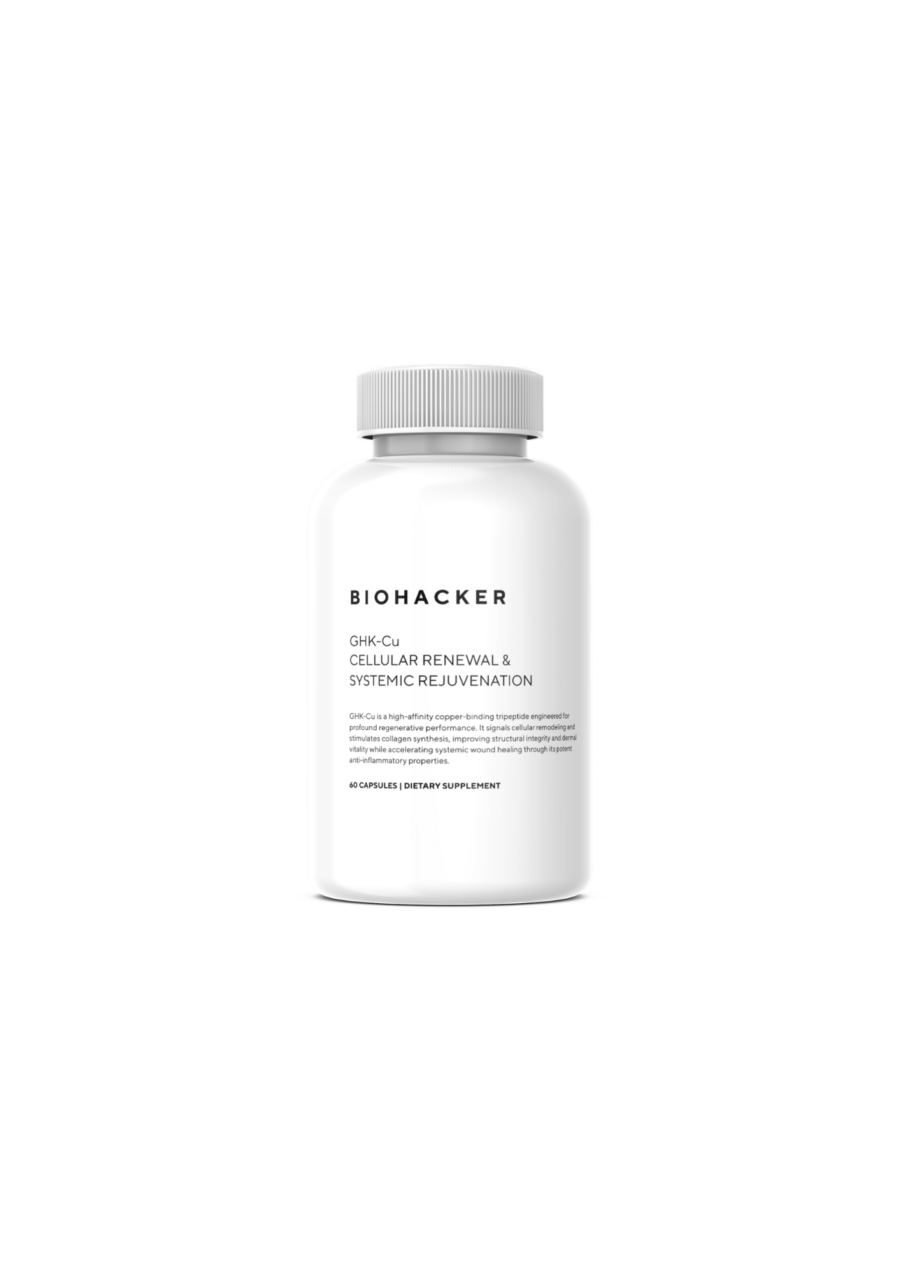
BIOHACKER formulates GHK-Cu in enteric-coated oral capsules — designed to survive gastric acid and deliver the active copper-chelate complex to the small intestine intact. The key challenge with free GHK-Cu is enzymatic (protease) degradation before the compound reaches systemic circulation. Enteric coating addresses this directly: by bypassing gastric acid and releasing the compound at intestinal pH, the formulation mirrors the protective effect of the carrier systems — liposomes, microemulsions, and hydrogel matrices — that have demonstrated three- to seven-fold improvements in bioavailability over unformulated compound in preclinical delivery studies. No needles. No reconstitution. No cold chain.
Specifications
| Attribute | Detail |
|---|---|
| Compound | Glycyl-L-histidyl-L-lysine copper complex (GHK-Cu) |
| Dose per capsule | 10 mg |
| Capsules per bottle | 60 |
| Purity | ≥99.54% (HPLC verified) |
| Form | Oral enteric-coated capsule |
| Storage | Cool, dry place. Refrigeration not required. |
| Endotoxin | Passed (<1 EU/mg) |
Frequently Asked Questions
What is GHK-Cu used for in research?
GHK-Cu is investigated across longevity, inflammation, tissue remodelling, neuroprotection, and oxidative stress research contexts. Preclinical models have examined its activity on mitochondrial dynamics, transcription factor pathways (DAF-16/FOXO, SKN-1/Nrf2), JAK1-mediated inflammatory cascades, collagen synthesis, and metal-ion cytoprotection in CNS cell lines. It is one of the most mechanistically characterised signalling molecules in the current bioregulator research literature.
Is GHK-Cu available as oral capsules?
Yes. BIOHACKER’s GHK-Cu is formulated in enteric-coated oral capsules at 10 mg per capsule, 60 capsules per bottle. Enteric coating is particularly relevant for GHK-Cu because the free tripeptide complex is susceptible to protease degradation in the gastric environment — enteric encapsulation delivers the intact copper-chelate complex to the small intestine for absorption.
What purity is BIOHACKER’s GHK-Cu?
99.54% HPLC-verified, with a full Certificate of Analysis available on the product page. Every batch is independently tested for identity, purity, and endotoxin levels before release.
Is this for human consumption?
No. GHK-Cu from BIOHACKER is sold strictly for in vitro research and laboratory use. It is not intended for human or veterinary use and is not a dietary supplement or pharmaceutical product.
Ready to order? Add to Cart — $70
For research use only. Not for human consumption. Not intended to diagnose, treat, cure, or prevent any disease. This product is sold exclusively for in vitro research and laboratory purposes.
V. Tanaka –
GHK-Cu at 99.6{bc6192475b1f7ab2a319df0d74882f1947535342342376b459ce77de5d749ac5} purity is exceptional. The copper chelation complex is intact — I verified the absorption spectrum before use. Biohacker is the only oral source I’ve found with this level of purity documentation. Will remain my primary source.
C. Adebayo –
Using GHK-Cu in wound healing research. The COA data matches the published literature’s expectations for what this compound should look like at research grade. Ordering process was straightforward, dispatch was same day, documentation arrived with the order.