Certificate of Analysis
Independent laboratory testing confirms purity and composition of this research compound.
ENDO PASSED
What Is Pinealon?
Pinealon is a synthetic tripeptide (Glu-Asp-Arg / EDR) developed within the Khavinson bioregulatory research programme as a pineal gland-derived signalling sequence. At approximately 446 Da, it is one of the smallest compounds in the short-peptide bioregulator class. In preclinical models, Pinealon acts at the level of DNA promoter regions — binding non-covalently to the major groove at guanine N7 and O6 positions — to modulate transcription of genes governing neuronal maintenance, antioxidant defence, and serotonin biosynthesis. Its primary research interest is neuroprotective and geroprotective signalling under conditions of oxidative stress, hypoxia, and neuronal aging.
What The Research Shows
Research demonstrates that Pinealon suppresses reactive oxygen species accumulation in a dose-dependent manner across multiple neuronal cell lines, including cerebellar granule cells and PC12 cells, activating ERK1/2 MAP kinase as a principal anti-apoptotic mechanism. In rat models of acute cerebral ischaemia, pre-treatment with Pinealon significantly reduced caspase-3 activity in brain tissue and improved post-occlusion behavioural outcomes in aged animals. In vitro molecular docking data confirm that the EDR sequence interacts with the CCTGCC motif in the tryptophan hydroxylase gene promoter, with corresponding upregulation of serotonin biosynthesis markers observed in aging cortical cell cultures. In a rat model of prenatal hyperhomocysteinemia, Pinealon administration normalised cerebellar antioxidant status and improved postnatal cognitive function in offspring. Under hypoxic conditions, Pinealon preserves mitochondrial function and demonstrates direct free-radical scavenging activity at the cellular level.
| Research Area | Model | Key Finding |
|---|---|---|
| ROS suppression & ERK activation | In vitro (cerebellar granule cells, PC12 cells, neutrophils) | Dose-dependent reduction in intracellular reactive oxygen species; ERK1/2 MAP kinase activation drove significantly increased cell viability under oxidative challenge versus untreated controls |
| Caspase-3 inhibition under ischaemia | Rat (carotid artery occlusion, aged animals) | Pre-treatment reduced caspase-3 activity in brain tissue and improved survival rates and behavioural outcomes compared to untreated occluded controls |
| Serotonin pathway upregulation | In vitro / rat cortical cell cultures | EDR docked to the CCTGCC motif in the tryptophan hydroxylase gene promoter; serotonin expression markers were upregulated in aging cortical cultures treated with Pinealon versus untreated aging controls |
| Neuroprotective gene expression | In vitro / review | EDR activated transcription and translation of neuroprotective proteins and reduced apoptosis intensity in neuronal cultures; molecular docking confirmed interaction with CCTGCC promoter DNA sequences |
| Prenatal neuroprotection | Rat (prenatal hyperhomocysteinemia model) | Pinealon administration during gestation significantly improved postnatal cognitive function and normalised cerebellar antioxidant status in offspring versus untreated hyperhomocysteinemia group |
| Antihypoxic & mitochondrial preservation | In vitro / rat | Pinealon demonstrated direct free-radical scavenging and preservation of mitochondrial function under hypoxic conditions in both cell culture and animal model settings |
Key Mechanisms
- DNA major groove binding: The EDR sequence penetrates the major groove of DNA at guanine N7 and O6 positions, modulating promoter-level gene transcription without covalent modification — a non-classical epigenetic-adjacent regulatory mechanism confirmed by NMR, spectroscopy, viscosimetry, and molecular dynamics simulation.
- Serotonin biosynthesis upregulation: Pinealon docks to the CCTGCC nucleotide motif in the promoter region of the tryptophan hydroxylase gene, the rate-limiting enzyme in serotonin biosynthesis, increasing its expression in aging cortical neuronal cultures.
- ROS suppression: Pinealon dose-dependently reduces intracellular reactive oxygen species accumulation under both receptor-dependent and receptor-independent oxidative stress conditions across multiple neuronal and immune cell types.
- ERK1/2 MAP kinase activation: ERK pathway engagement following Pinealon exposure promotes cell cycle progression and delivers anti-apoptotic signalling, representing the primary mechanism underlying the observed cell viability increases in oxidative challenge models.
- Caspase-3 downregulation: Pre-treatment with Pinealon reduces caspase-3 activity in brain tissue under acute ischaemic conditions, indicating downstream inhibition of the intrinsic apoptosis cascade.
- Antioxidant status normalisation: In developmental rat models, Pinealon restores cerebellar antioxidant capacity disrupted by elevated homocysteine exposure, with corresponding improvements in offspring cognitive performance.
- Mitochondrial function preservation: Under hypoxic energetic stress, Pinealon maintains mitochondrial integrity and exerts direct free-radical scavenging activity, supporting cellular bioenergetic resilience in neuronal tissue.
Why Oral Capsules?
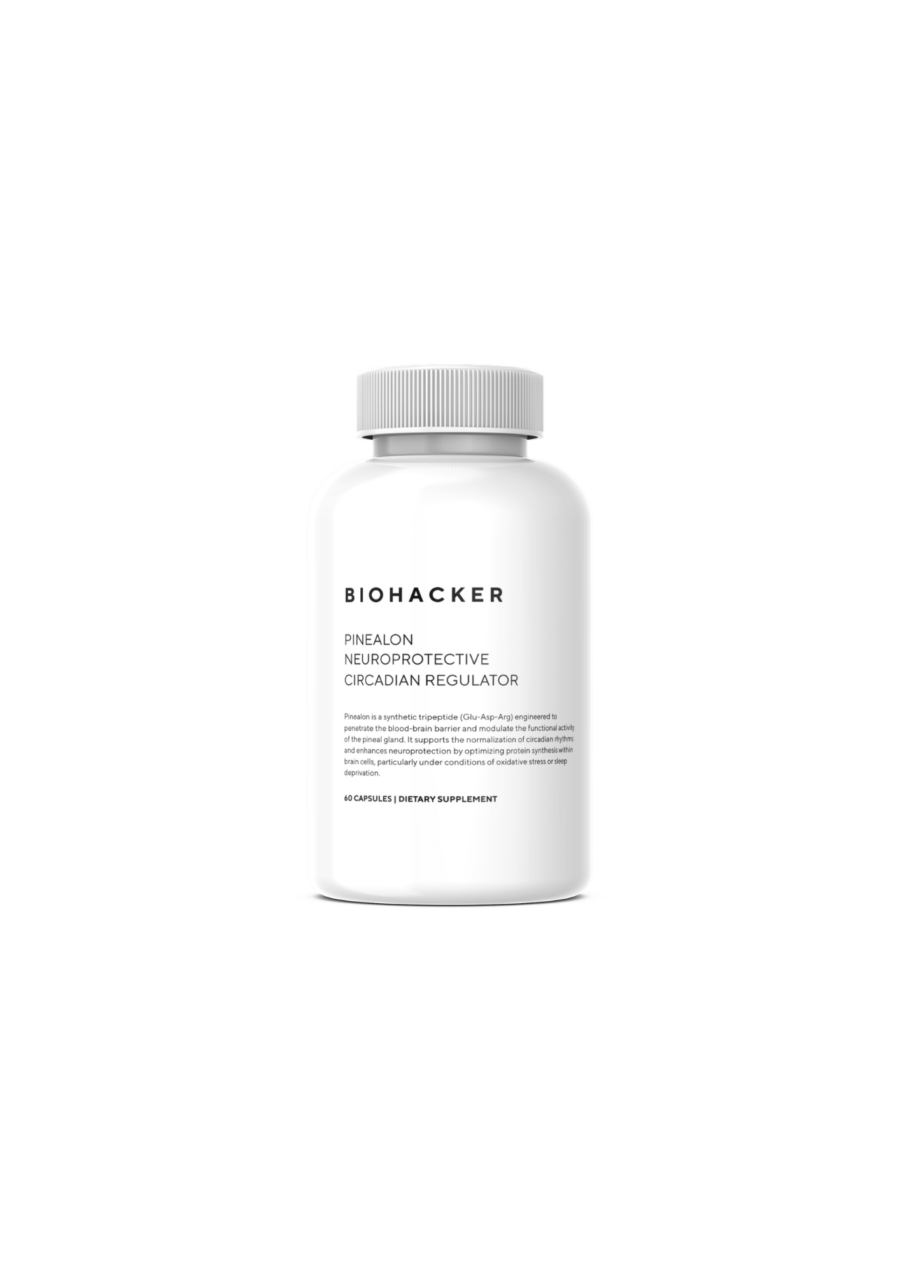
BIOHACKER formulates Pinealon in enteric-coated oral capsules — designed to survive gastric acid and deliver the active sequence to the small intestine intact. At approximately 446 Da, the Glu-Asp-Arg tripeptide falls within the molecular weight range associated with partial paracellular and transcellular absorption of short peptides in the gastrointestinal tract. Preclinical data confirms systemic bioactivity from oral and systemic administration across multiple model types. No needles. No reconstitution. No cold chain.
Specifications
| Attribute | Detail |
|---|---|
| Compound | Pinealon (Glu-Asp-Arg / EDR tripeptide) |
| Dose per capsule | 10 mg |
| Capsules per bottle | 60 |
| Purity | ≥99.58% (HPLC verified) |
| Form | Oral enteric-coated capsule |
| Storage | Cool, dry place. Refrigeration not required. |
| Endotoxin | Passed (<1 EU/mg) |
Frequently Asked Questions
What is Pinealon used for in research?
Pinealon (Glu-Asp-Arg) is investigated primarily in the contexts of neuroprotection, neuronal aging, and oxidative stress modulation. Preclinical research has examined its role in suppressing ROS accumulation in neuronal cell lines, reducing apoptotic signalling under ischaemic conditions, upregulating serotonin biosynthesis pathways via promoter-level DNA interaction, and preserving mitochondrial function under hypoxic stress. It is also studied as part of the broader Khavinson short-peptide bioregulator class for geroprotective applications.
Is Pinealon available as oral capsules?
Yes. BIOHACKER’s Pinealon is formulated in enteric-coated oral capsules at 10 mg per capsule, 60 capsules per bottle. The enteric coating is designed to protect the active sequence from gastric acid degradation, enabling release in the duodenum where short-peptide absorption via paracellular and transcellular routes is most viable at Pinealon’s molecular weight of approximately 446 Da.
What purity is BIOHACKER’s Pinealon?
99.58% HPLC-verified, with a full Certificate of Analysis available on the product page. Every batch is independently tested for identity, purity, and endotoxin levels before release.
Is this for human consumption?
No. Pinealon from BIOHACKER is sold strictly for in vitro research and laboratory use. It is not intended for human or veterinary use and is not a dietary supplement or pharmaceutical product.
Ready to order? Add to Cart — $120
For research use only. Not for human consumption. Not intended to diagnose, treat, cure, or prevent any disease. This product is sold exclusively for in vitro research and laboratory purposes.
R. Svensson –
Pinealon is a niche compound and finding it at 99{bc6192475b1f7ab2a319df0d74882f1947535342342376b459ce77de5d749ac5}+ purity is difficult. Biohacker stocks it with full COA documentation and same-day dispatch. The capsule format is practical for the kind of repeated low-dose protocols this compound is typically used in.
F. Russo –
Clean documentation, fast shipping, purity consistent with the certificate. I’ve been researching neuroprotective peptides for two years and Biohacker is the only source I’ve found that publishes endotoxin data alongside purity. That matters.